
Finding Your People: The Power of Challenging Networks in Education
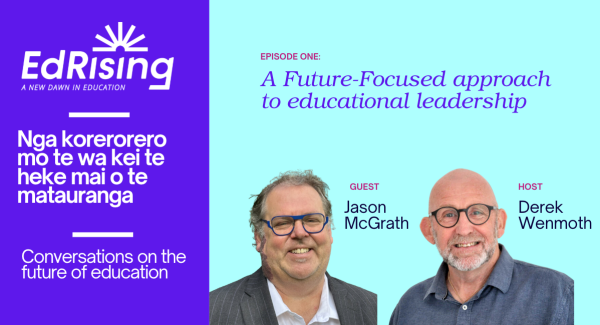
EdRising blog and podcast - Conversations on the future of education with Derek Wenmoth (Aotearoa - New Zealand) and Jason McGrath (Australia).
The conversation is the first in a series of “Conversations about the future of education” that Derek is planning to produce as part of his involvement with the EdRising project.
“Listening back to this conversation, what stays with me is Jason’s insistence that the future of schooling is not something any of us can design alone. His core advice is simple but demanding: talk to each other more, and talk better.”
Here is an excerpt from our conversation where I share a few ideas about creating a culture of innovation:
Innovation culture (transcript excerpt, 9.15)
“… Pilots are very useful but there's a there's actually a more broader set of pilots that we should be looking at. For example, there's lighthouse pro projects where something is known to be working and then we're trying to spread that.
There's also a concept called sufficing standard of evidence. So we often talk about the gold standard of random control trials but some of the research suggests that in terms of looking at the future which is much different and more complex than the past we should be looking at what's called a sufficing standard where we ensure that we know that the kernel of the innovation is solid in terms of the research but then we allow more space for that to happen in different contexts. We allow it to be contextualised and what it does is it actually changes the role between bottom up and top down. Top down have a different role and that role is to evaluate to put the guardrails around innovation make sure that things are you know are reasonable, to be evaluating what is actually making more of a difference to celebrate those successes. It’s a change in thinking that their job is to actually see some of these successes and amplify it. That's a different way of operating to create this culture and to allow change.
Education International makes the point that with the complex world and changing world, schools are already innovating and they talk about these micro innovations that aren't always curated. We don't always identify them even though we all know that the one of the greatest ways to get positive change is to identify where change is already happening sustainably and to learn from that. And I think if we need to spend a bit more time identifying some of those changes, curating it and sharing it as part of that innovation culture.
I would also talk about the concept of the school next door. We need to make sure that we start connecting schools. Not just in professional learning communities, but more directly: if you've got if there's a teacher with a passion or strength in a particular area who may not want to present to 200 people, they might be happy to share that expertise with the school next door. And so we need to look at opportunities to share that because again people when people talk in context. If I know that the school next door is similar to my school and this is how they do it and they're having success, I will would love to learn about these things and to then maybe see how what how that motivates the work that I'm doing. It may not I'm not necessarily again to be policy borrowing or teach borrowing that particular approach, although I might if I think it's that great, but I want to learn from it. And so it's these opportunities to I call it innovation culture.
Innovation's not always seen as a positive word, but next practice has two parts to it. One is the novel and experimentation doing things differently. But just as importantly, next practice is also about reframing current practice for contemporary needs. And so having the opportunity to reflect on what we're currently doing and seeing how we can tweak it is just as important as coming up with a new pilot for example.”
“If we each acted... even in small ways, we would begin to build the kind of cross-system dialogue... that keeps our focus on a richer, longer-term future for learners, even when the pressures around us try to drag us back to the past.”
